Most people believe their patterns are permanent. Whether you have an anxious mind or tend to shut down, these can feel like fixed parts of who you are. This belief is understandable, but it is not neurologically accurate.
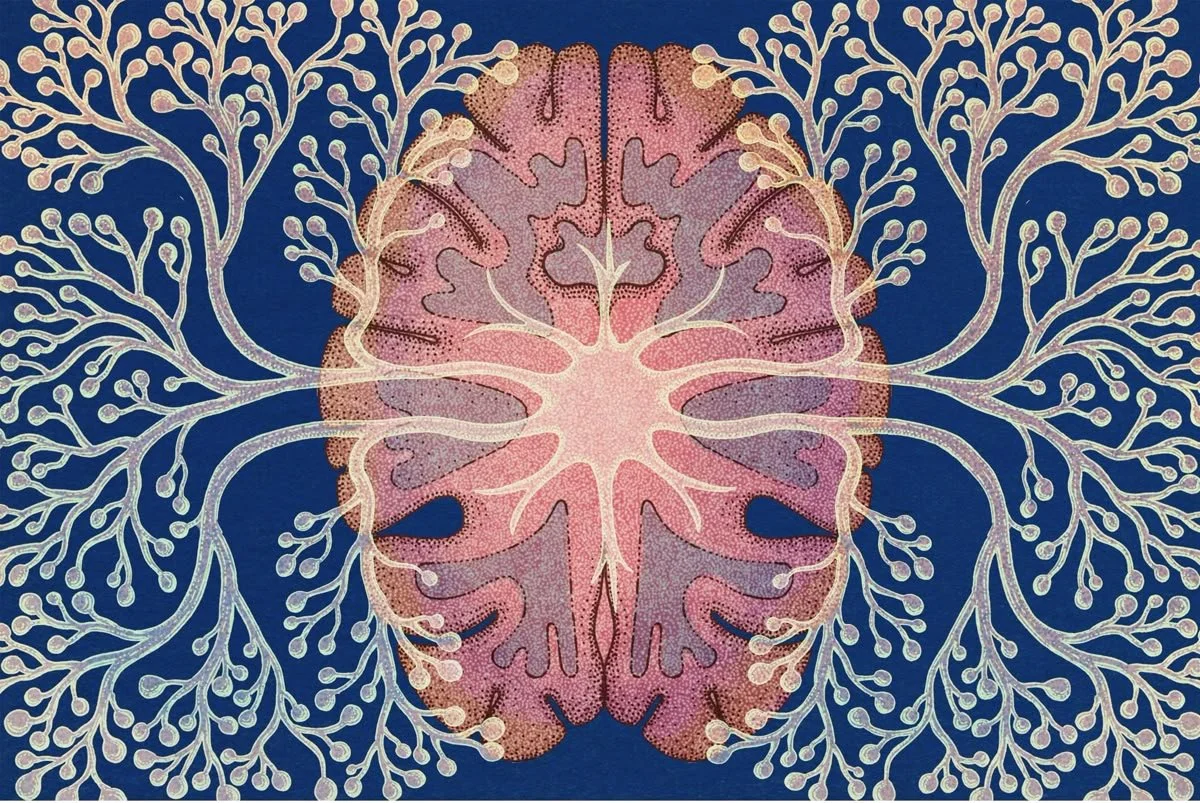
Neuroplasticity is the nervous system’s capacity to reorganise its structure, functions, and connections in response to experience [1]. The brain is constantly remodelling itself based on what it repeatedly does. Every thought, movement, and breath either strengthens an existing neural pathway or begins to weaken it.
This matters because it means your patterns were learned, and what is learned can be reshaped.
The Hindbrain’s Role in Regulation
To understand how yoga drives this change, it helps to start at the base of the brain.
Most people know the cerebellum as the structure responsible for balance and coordination, which is why it is clearly active during asana practice (the physical postures we typically associate with yoga). But newer research shows it does far more than that. The cerebellum is involved in emotional processing, social processing, and cognitive coordination [2].
This is why a grounding practice can feel like more than just physical movement. While you practice your balance, you’re engaging a structure that is increasingly understood to be involved in emotion regulation [3].
The Cerebellum and the Prefrontal Cortex
The cerebellum forms dense reciprocal connections with the prefrontal cortex, the region responsible for executive function, decision-making, emotional regulation, and cognitive flexibility [4].
A well-regulated cerebellum supports a well-regulated prefrontal cortex [5]. This is the neurological basis for something you may have felt in your own practice: that a steady, coordinated asana sequence leaves you clearer and more emotionally balanced.
Consider Tree Pose. Holding it requires physical stability (cerebellum function) and focused attention (prefrontal function). Repeatedly practising it strengthens the pathways between them. Over time, this is training the brain’s capacity for top-down regulation of emotion.

How Yoga Drives the Change
Yoga is well suited to neuroplastic change because it works through multiple channels at once.
Breathwork directly influences the brainstem and shifts autonomic balance from sympathetic arousal toward parasympathetic tone. This is the mechanism behind the vagus nerve work as slow exhales stimulate the parasympathetic response. [6]
Asana builds interoceptive awareness. Research on long-term yoga practitioners has found that insular grey matter volume, a region central to interoception, correlates positively with yoga experience [7]. During practice, the brain receives rich sensory information about where the body is, how it is moving, and what it feels like. Over time, this kind of repeated sensory input is thought to strengthen the connections between the somatosensory cortex and the insula, where internal sensation is processed.
Meditation has been shown to increase grey matter density in areas associated with awareness and self-regulation, including the orbito-frontal cortex and the hippocampus [8].
The cumulative effect is that a consistent practice is a structured, repeated stimulus that reshapes how your nervous system responds to stress. This is how yoga is different from mere stretching, breathing, or exercise.
Consistency > Intensity
Neuroplastic change responds to frequency more than duration. A five-minute practice done daily will create more lasting change than a ninety-minute class done once a week. And if even that feels difficult, know that this is not a sign of failure. The brain is wired to repeat familiar patterns, even painful ones, because familiar is efficient. Change feels uncomfortable only because it is unfamiliar to the brain.
What This Means in Practice
Your patterns are your current neural wiring, shaped by repetition over years, but they are not your identity. This means that the same mechanism that built them can reshape them. But this can’t be done through insight alone or just by understanding the roots of your problem. This can be done through repeated practices like breathwork, meditation, or asana, even if the practice feels small.
References
[1] Fuchs, E., & Flügge, G. (2014). Adult neuroplasticity: More than 40 years of research. Neural Plasticity, 2014, 541870. https://doi.org/10.1155/2014/541870
[2] Van Overwalle, F. (2024). Social and emotional learning in the cerebellum. Nature Reviews Neuroscience, 25(12), 776–791. https://doi.org/10.1038/s41583-024-00871-5
[3] Oboshi, Y., Kondo, H., Iwabuchi, T., Kikuchi, M., Kobayashi, K., Itoh, M., Kato, S., & Ishii, T. (2025). Cerebellar contribution to emotion regulation and its association with medial frontal GABA level. Social Cognitive and Affective Neuroscience, 20(1), nsae091. https://doi.org/10.1093/scan/nsae091
[4] Watson, T. C., Becker, N., Apps, R., & Jones, M. W. (2014). Back to front: Cerebellar connections and interactions with the prefrontal cortex. Frontiers in Systems Neuroscience, 8, 4. https://doi.org/10.3389/fnsys.2014.00004
[5] Kelly, E., Meng, F., Fujita, H., Morgado, F., Kazemi, Y., Rice, L. C., Ren, C., Escamilla, C. O., Gibson, J. M., Sajadi, S., Pendry, R. J., Tan, T., Ellegood, J., Basson, M. A., Blakely, R. D., Dindot, S. V., Golzio, C., Hahn, M. K., Katsanis, N., … Tsai, P. T. (2020). Regulation of autism-relevant behaviors by cerebellar-prefrontal cortical circuits. Nature Neuroscience, 23(9), 1102–1110. https://doi.org/10.1038/s41593-020-0665-z
[6] De Couck, M., Caers, R., Musch, L., Fliegauf, J., Giangreco, A., & Gidron, Y. (2019). How breathing can help you make better decisions: Two studies on the effects of breathing patterns on heart rate variability and decision-making in business cases. International Journal of Psychophysiology, 139, 1–9. https://doi.org/10.1016/j.ijpsycho.2019.02.011
[7] Villemure, C., Čeko, M., Cotton, V. A., & Bushnell, M. C. (2014). Insular cortex mediates increased pain tolerance in yoga practitioners. Cerebral Cortex, 24(10), 2732–2740. https://doi.org/10.1093/cercor/bht124
[8] Luders, E., Toga, A. W., Lepore, N., & Gaser, C. (2009). The underlying anatomical correlates of long-term meditation: Larger hippocampal and frontal volumes of gray matter. NeuroImage, 45(3), 672–678. https://doi.org/10.1016/j.neuroimage.2008.12.061